



Shaadi on a Shoestring - 12 Budget-Friendly Stalls for Indian Destination Weddings in 2026
Introduction:
By the time most couples begin planning guest activities for their Indian destination wedding, most of the budget has already disappeared into the obvious things - the venue, the décor, the outfits, the entertainment, the logistics. Experience stalls are usually pushed into the “optional” category. Which is ironic, because those are often the details guests remember most clearly long after the wedding ends.
At Eternal Weddingz, after planning destination weddings across Udaipur, Goa, Jaipur, and Karjat, Lonavala, one pattern keeps repeating itself: guests rarely spend months talking about the stage design or the imported orchids. They talk about the caricature artist who captured their entire friend group in five minutes. The gajra stall was crowded around before the Sangeet. The live illustrator sketches moments in real time.
The best part is that most of these experiences are surprisingly practical from a budget perspective. A live caricature artist for a four-hour Sangeet often costs less than a single oversized floral installation. Calligraphy booths, bangle bars, nail art counters, and perfume blending stations deliver far more guest engagement per rupee because you are paying for participation and memory-making, not just visual impact.
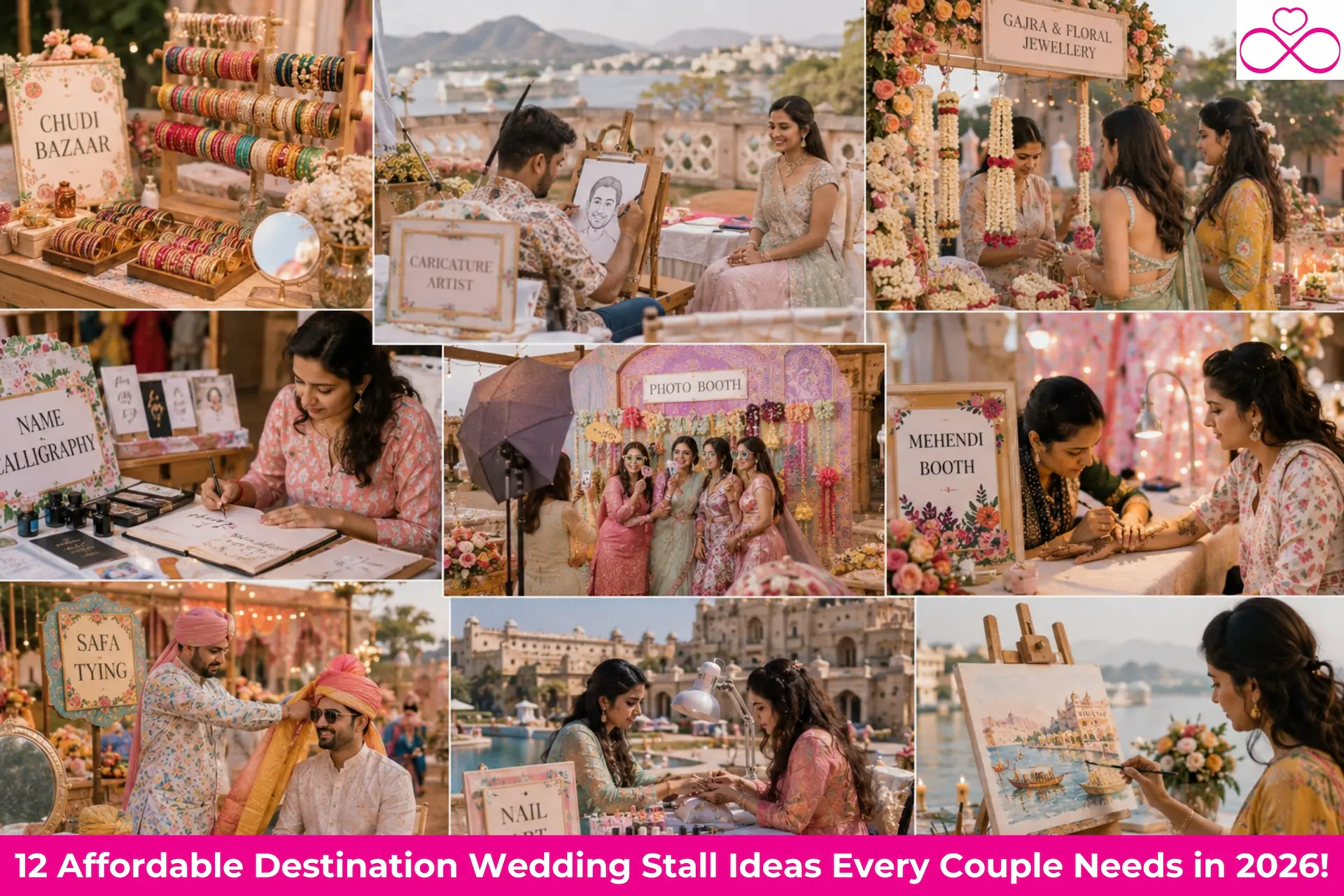
This list covers 12 budget-friendly guest experience stalls that genuinely work at Indian destination weddings - not because they are trendy on social media, but because they consistently create movement, conversation, and participation across different age groups. The final section also breaks down which combinations work best together depending on the destination, guest mix, and wedding function.
1. Saree Draping Artist:
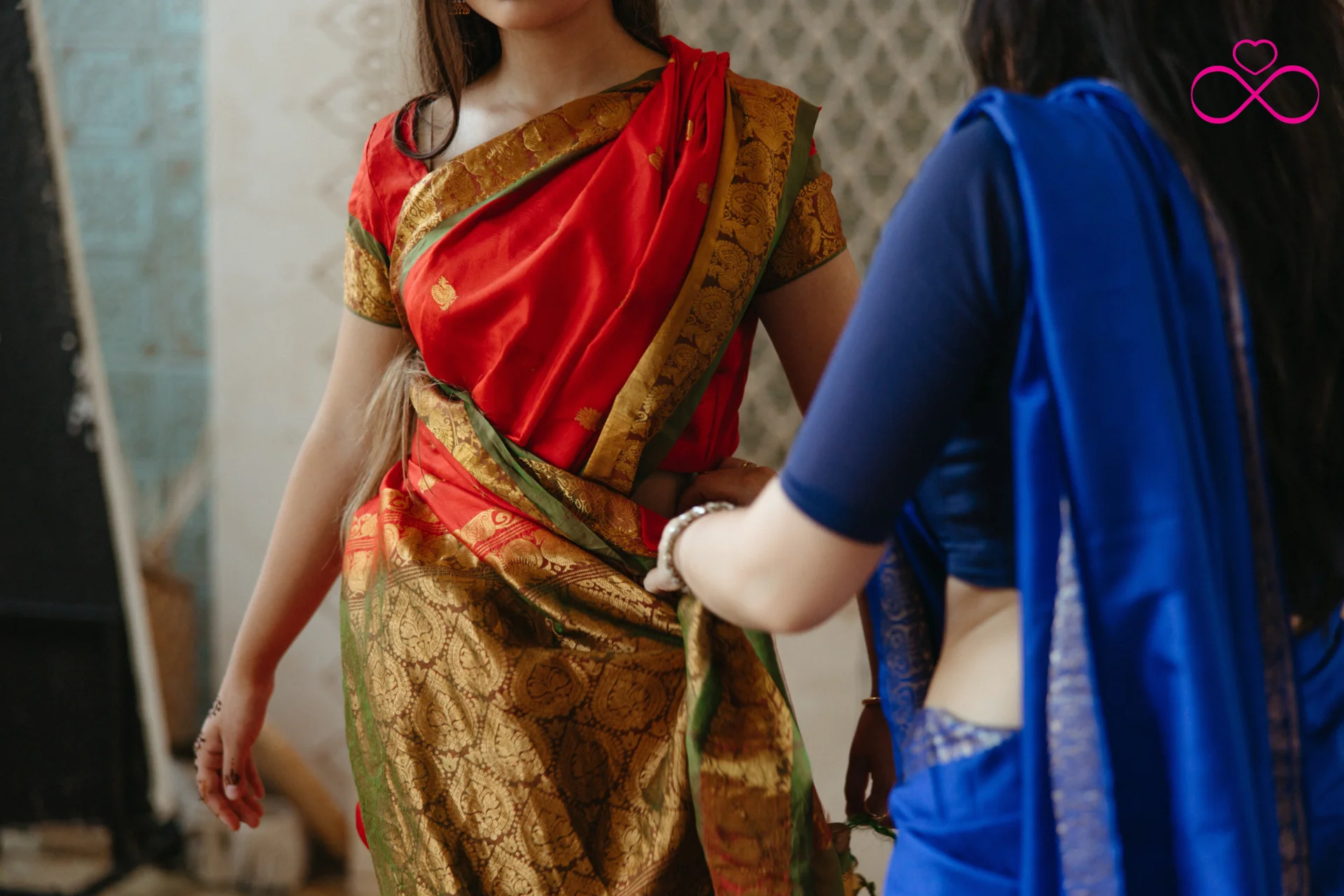
Every destination wedding has at least two or three guests who arrive holding a saree they have not worn in years and genuinely cannot drape themselves. A professional draping artist sorts this out quickly and without fuss - and what would otherwise be a frustrated guest wrestling with six metres of fabric in a venue bathroom becomes a five-minute stall visit. Put a full-length mirror nearby, and the queue forms on its own from hour one.
Good artists know multiple regional styles - Nivi, Bengali, Gujarati seedha pallu, modern butterfly - and can read what a guest needs in thirty seconds. The stall takes up almost no physical space and costs around ₹12,000 for a four-hour session. If your wedding has a saree dress code for guests, this stops being optional entirely.
Best suited for:
- Mehendi and Sangeet - where sarees are most common as guest attire.
- Destination weddings in Udaipur, Jaipur, or Jaisalmer with NRI or out-of-region guests who are away from their usual support systems.
- Any function with a specific ethnic dress code or colour coordination request.
2. Nail Art Stall (Quick Designs for Bridesmaids and Guests):
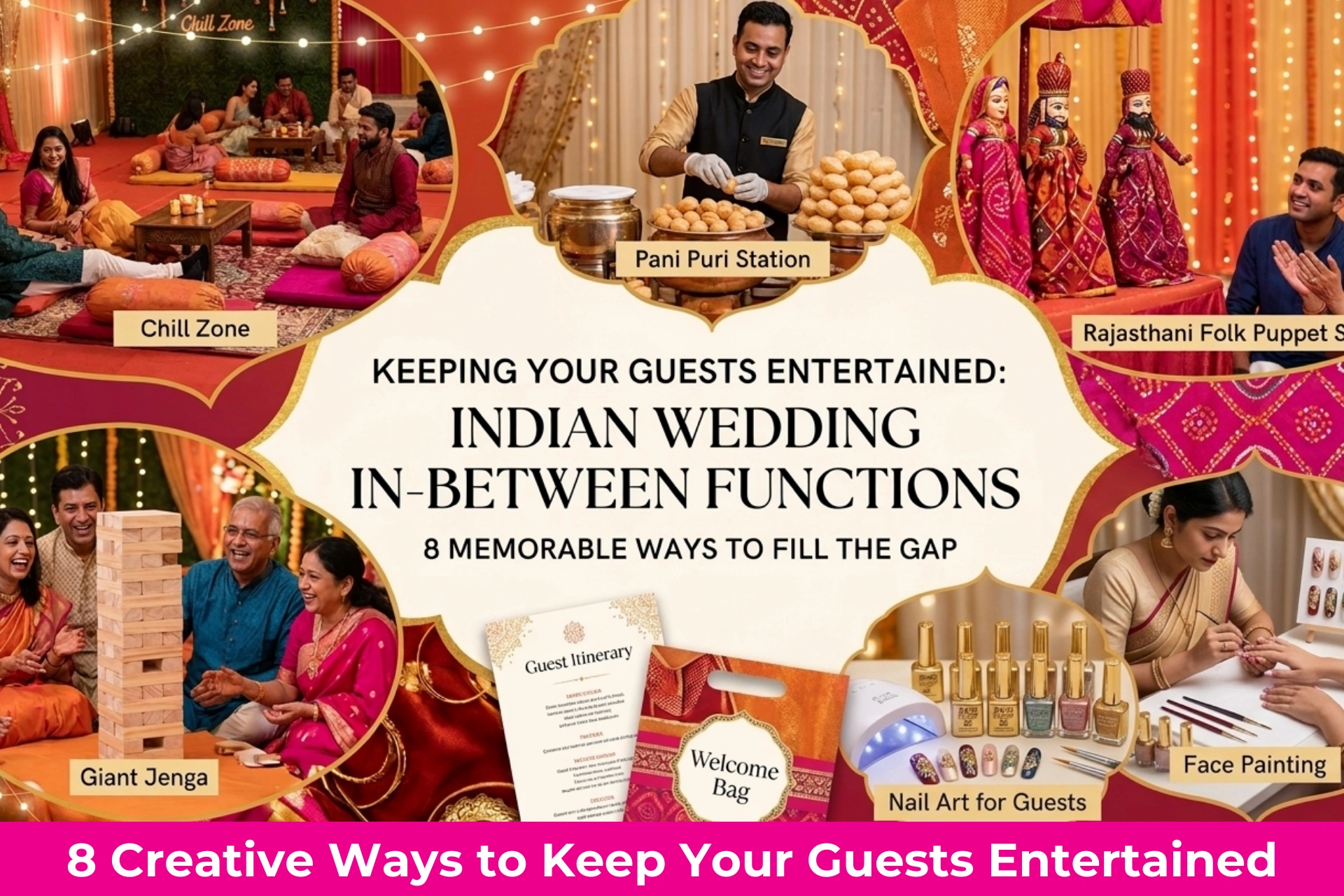
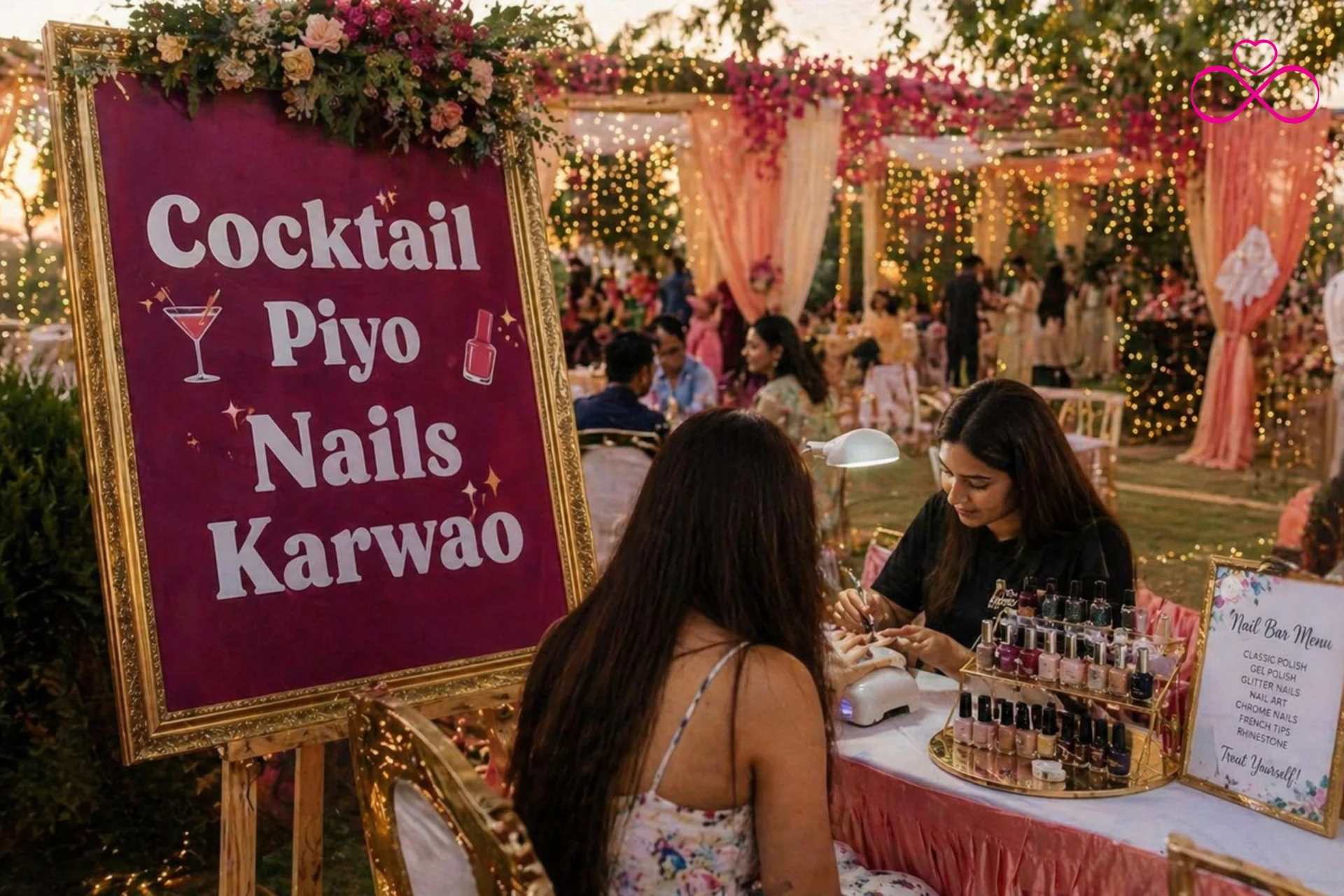
This isn't a salon manicure. A nail art stall at a wedding runs on a different model - quick accent designs, gel overlays on two or three fingers, micro art on a single statement nail - done in 10–15 minutes. Fast enough to keep a queue moving, personal enough that every guest walks away with something specific to them. Bridesmaids are the obvious draw, but you'll also get guests in their 30s and 40s who weren't planning to stop and end up sitting down anyway.
The detail that separates a good stall from a forgettable one: matching the palette to the wedding colour scheme. If your Mehendi is in dusty rose and marigold, those colours should be at the nail stall too. Guests photograph their nails alongside their bangles and gajra - all in one shot. One skilled artist is better than two average ones; quality here shows up immediately.
Best suited for:
- Mehendi morning, Haldi afterglow, and pre-wedding bridesmaids events.
- Intimate destination weddings where personalised guest touches carry more weight.
- Weddings with a younger, urban guest list - nail art is more mainstream than ever in India in 2026.
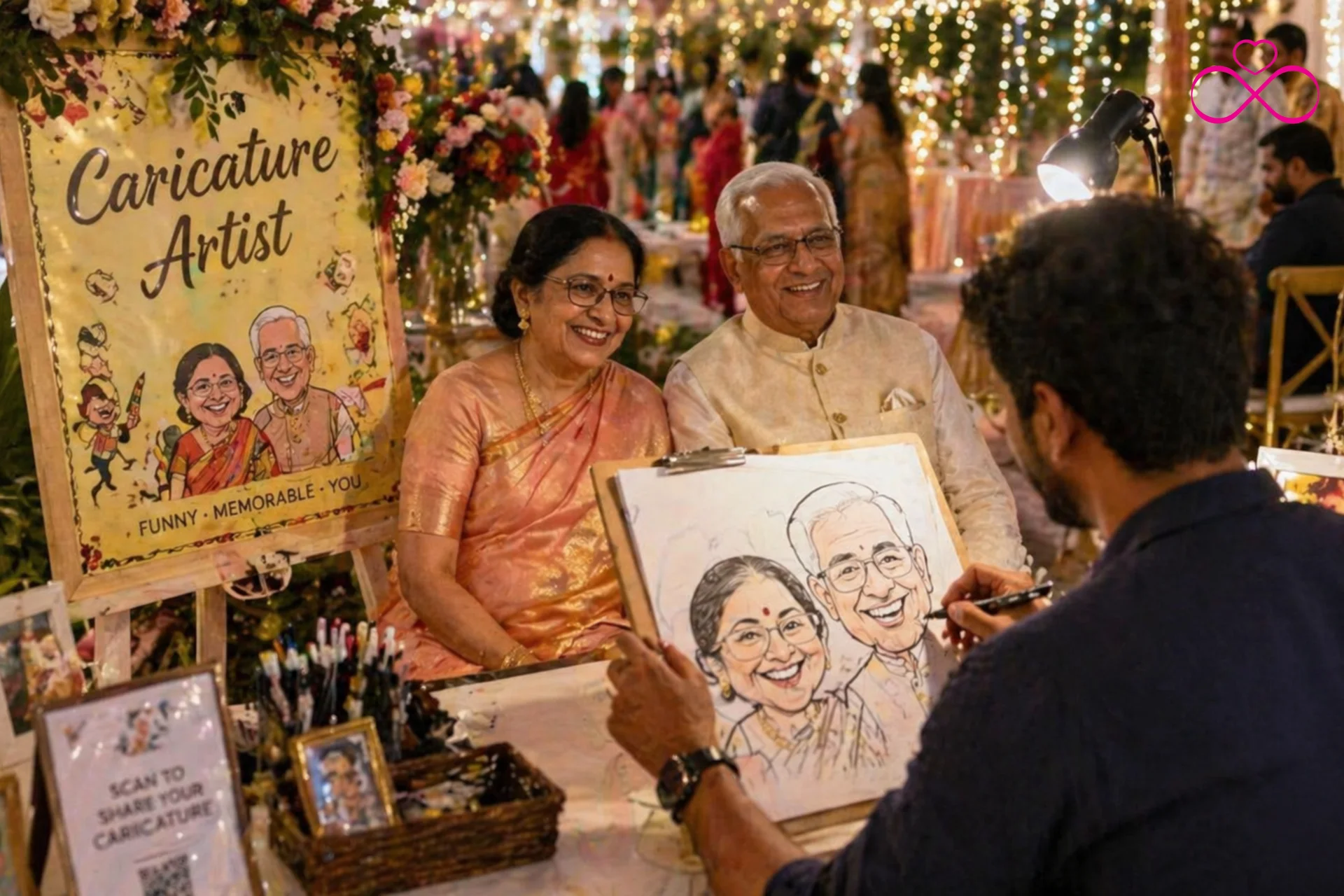
3. Caricature Artist - The One Stall That Creates Its Own Crowd
If you only book one guest experience stall for your entire destination wedding, book a caricature artist. A guest sits down, the artist works for eight to ten minutes, the sketch is revealed, and the guest sees their exaggerated nose or oversized smile and laughs - in front of everyone around them. Those people then want one. It is the only stall on this list that reliably generates its own queue without any prompting from the hosting team, and it does this at every function type and across every age group.
A photo booth print is anonymous. A caricature is made specifically for the person sitting in that chair. Guests keep these for years - they end up on refrigerators and office desks. Ask the artist to add the wedding date and couple's names at the bottom of every sketch; it turns a funny drawing into a dated keepsake. Digital caricature stations (tablet-based, instantly shareable) are also gaining ground at destination weddings in 2026 for couples with an active hashtag strategy. Budget around ₹20,000 for a 4-hour session.
Best suited for:
- Sangeet night and cocktail hour - guests are relaxed and looking for something to anchor them.
- Multi-day destination weddings in Goa, Udaipur, or Jaipur, where the same guests are together across multiple functions.
- Any wedding with a young, social-media-active guest list - caricature content gets shared organically and reliably.
4. Themed Photo Booth with Props
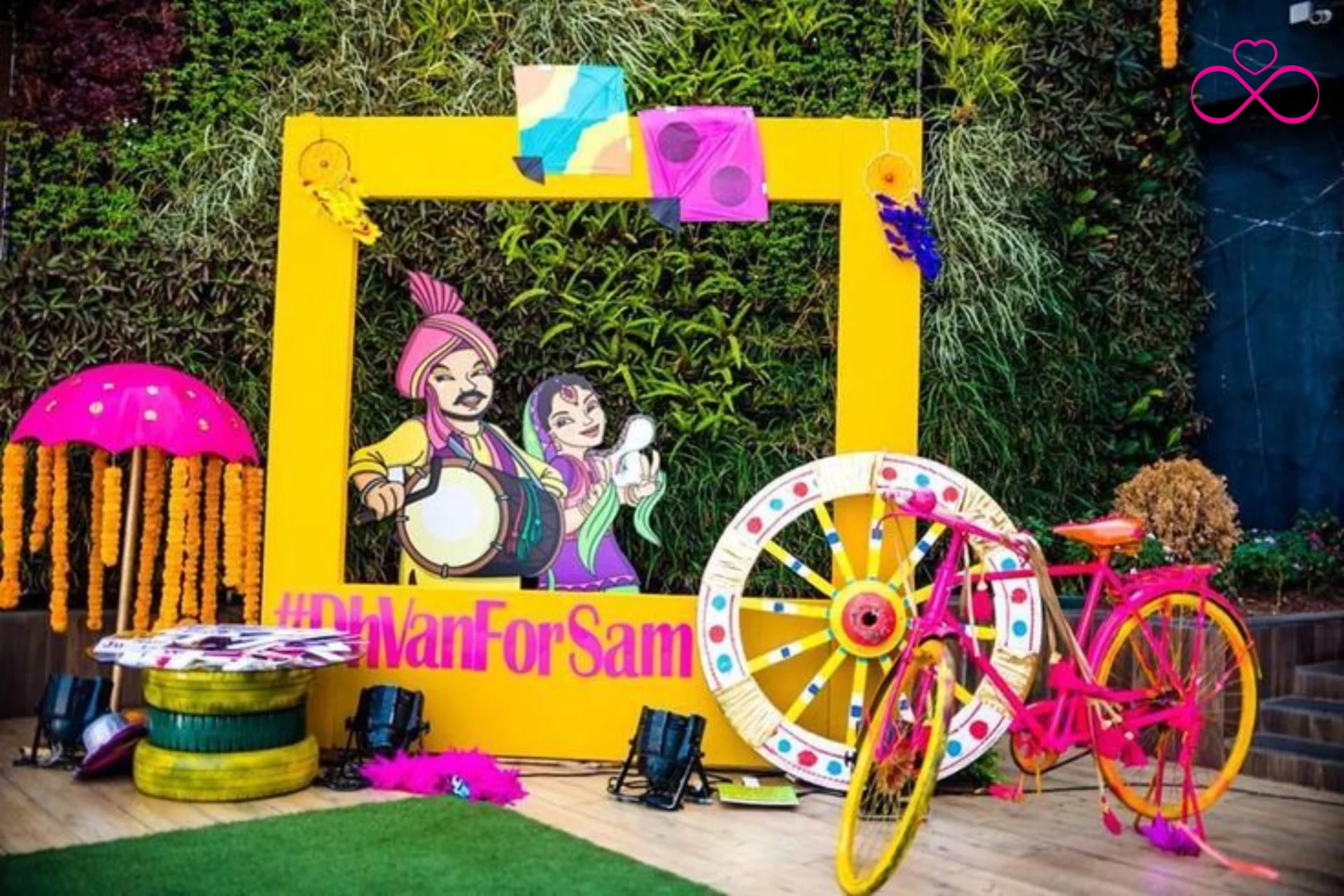
A folding backdrop and a pile of cardboard signs don't cut it anymore - guests have seen that at three other weddings this year. What still works is a photo booth that's been built as part of the wedding's visual world. At destination venues, the architecture usually does most of the work. A jharokha window at a Rajasthani haveli, a floral tunnel at a garden venue, a stretch of fairy lights against a stone wall - these are natural photo moments. Your job is to put the right light and the right props in front of them.
Props in 2026 should be specific, not generic. Personalised signs in your wedding font, destination-relevant items (a small boat for Goa, a Punjabi dhol for a Punjabi Wedding), floral crowns, miniature safas. If budget allows, add a Polaroid or instant-print element - a physical print changes the experience from digital to tangible in a way guests notice. A well-designed booth produces more organic guest content than almost any other element at a destination wedding, simply because guests photograph themselves there without being asked to.
Best suited for:
- Every function - this is the one stall that works universally across Mehendi, Sangeet, cocktail, and reception.
- Destination weddings, where the venue architecture and backdrop add visual value for free.
- Couples who want to engage their crowds as much as possible and who are looking to maximise organic guest content.
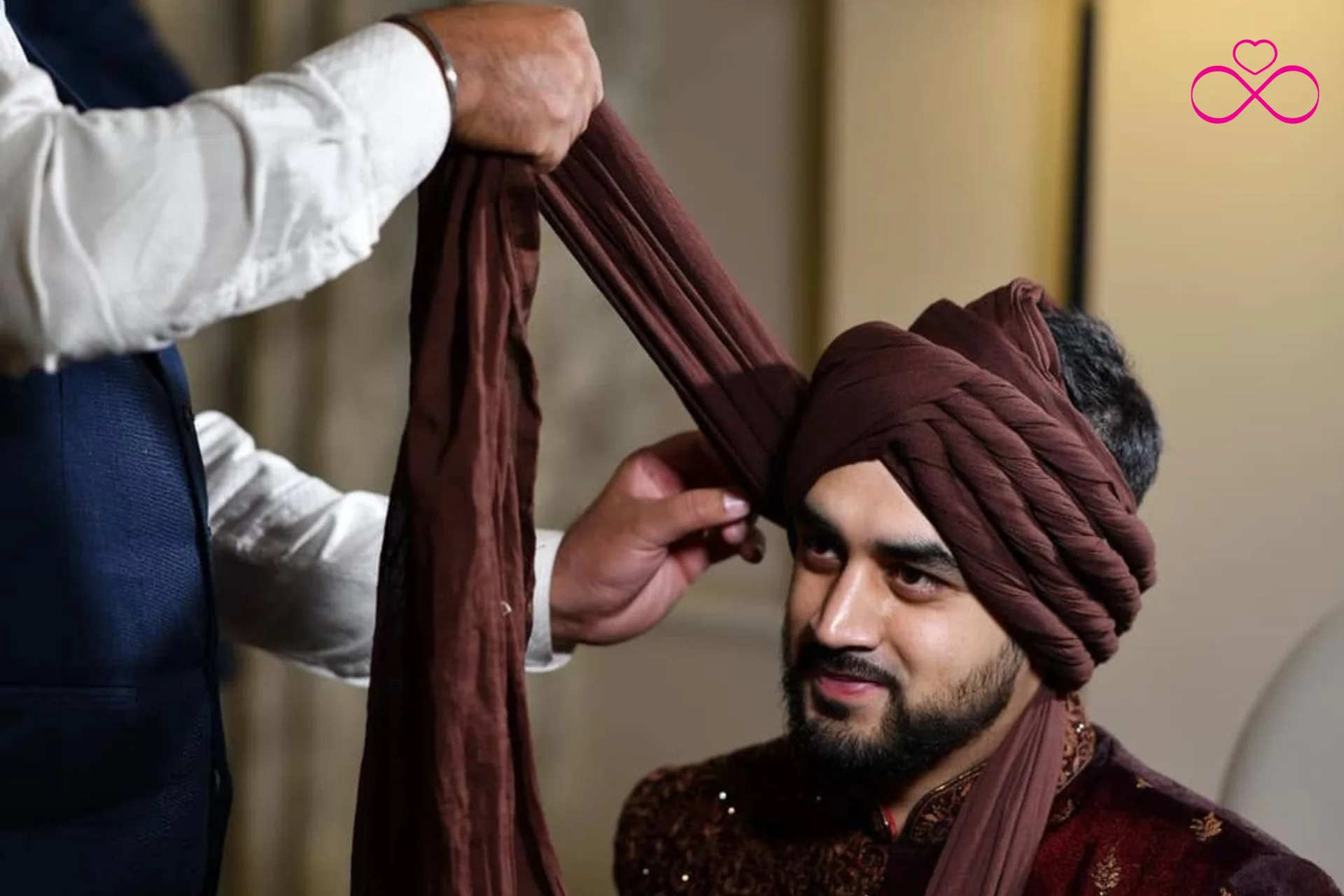
5. Safa / Pagdi Tying Stall
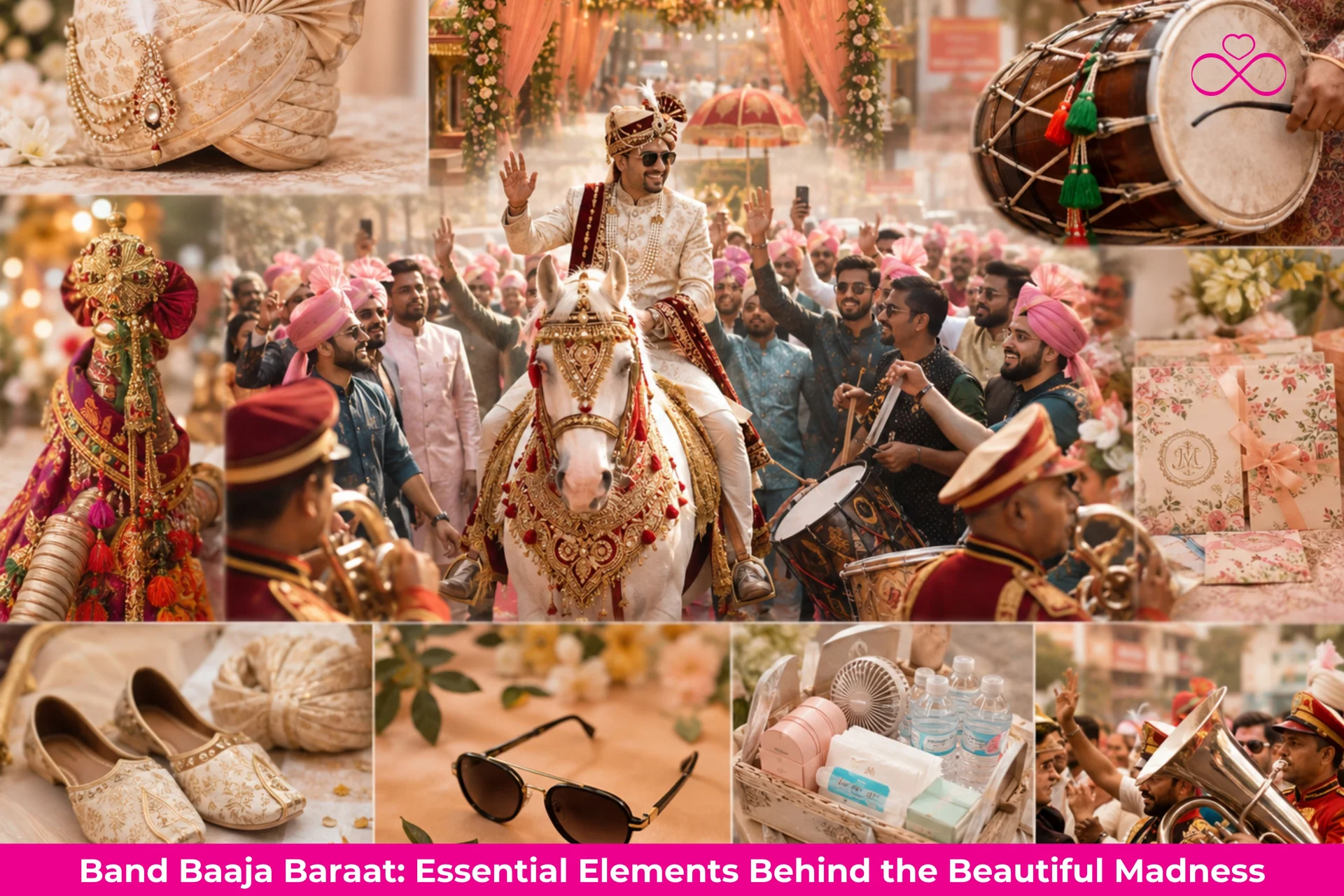
A Safa tying stall fits a Rajasthani destination wedding the way almost nothing else does - it is a direct extension of where guests are, not a novelty imported from somewhere else. Male guests over 55 sit down with a quiet seriousness that tells you it means something. Guests in their 20s and 30s photograph each other and post immediately. NRI and international guests approach it with genuine curiosity and tend to be the most enthusiastic about the result.
Stock safa fabrics in your primary wedding colour and a few complementary shades. Have someone on hand to help guests keep the turban in place - they come undone if not properly secured, and a guest spending twenty minutes re-tying their safa alone in a corner is avoidable. Artists who know four or five regional tying styles (Rajasthani, Marwari, Punjabi, Gujarati) keep the stall interesting even for repeat visitors.
Best suited for:
- This is a must for all weddings, especially before the Wedding Ceremony for both the guests coming from the bride's and the groom's side.
- Can also be used as a welcome event when guests are arriving and settling into the destination.
- Weddings with a large proportion of NRI or international guests are experiencing Rajasthani culture for the first time.
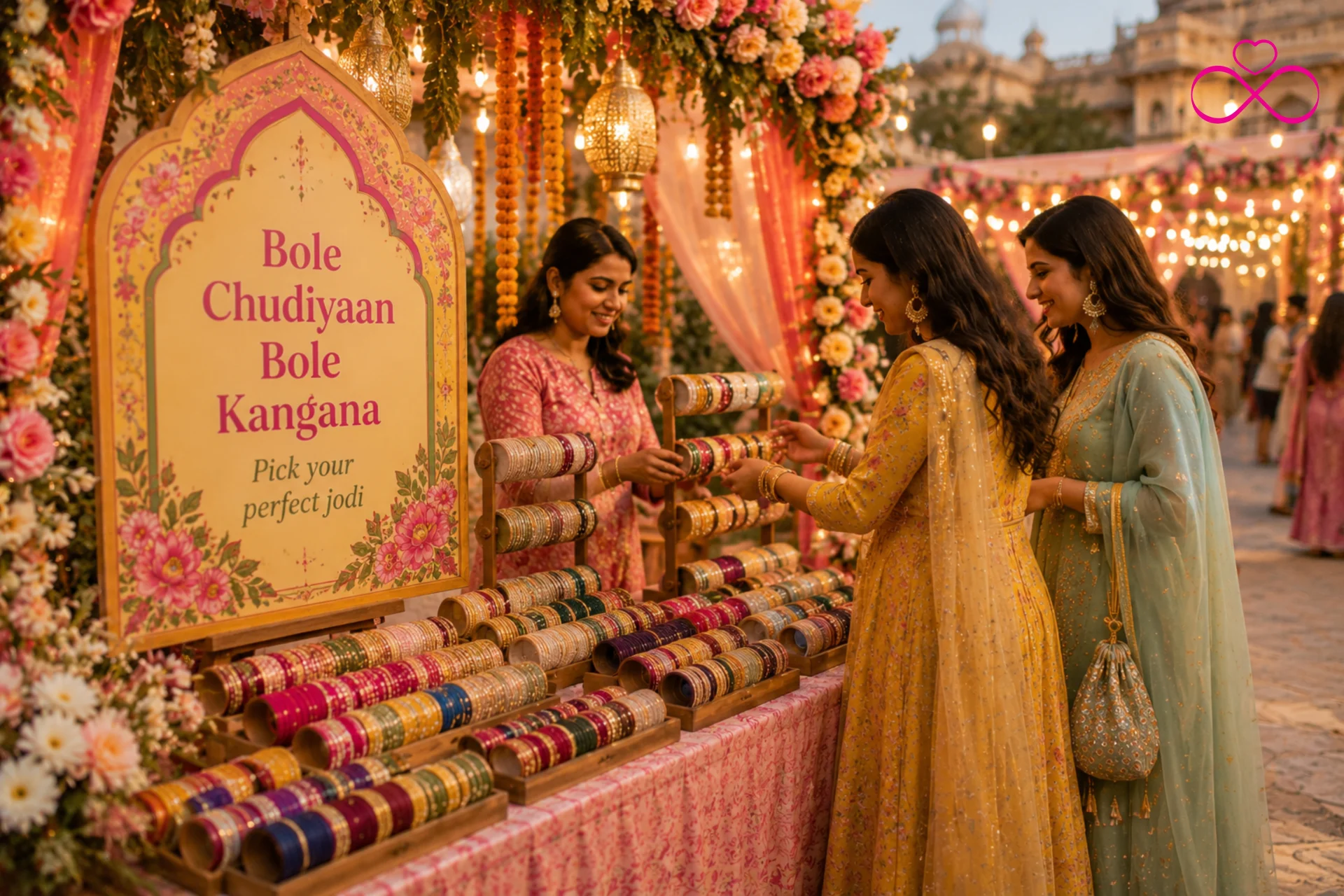
6. Bangle Stall - Chudi Bazaar Setup
A Chudi Bazaar stall done well looks like a small market corner - bangles arranged by colour and material, displayed on cone holders or velvet trays, with a vendor who knows how to fit them without fuss. Glass, lac, metal, kundan, mirror work, oxidised silver - the variety matters. Guests who planned their outfits perfectly still stop to look. Guests who forgot bangles entirely find their look suddenly complete. Bangles at a wedding are an impulse decision driven by colour and proximity, and the stall is built around exactly that.
You can run it as a gifting stall (you cover the cost, guests choose and take home bangles as a wedding favour) or as a paid stall where the vendor handles transactions. Both work. The gifting version removes any awkwardness around money at a wedding; the paid version keeps your upfront cost to just the setup. Either way, colour coordinate the selection to your Mehendi décor - guests photograph their wrists against the backdrop, and the images look intentional rather than accidental.
Best suited for:
- Mehendi function - bangles and Mehendi are inseparable, and the stall fits the function's character perfectly.
- Sangeet evening with a Mela or bazaar-style entertainment theme.
- Destination weddings around the traditional Rajasthani theme where lac bangles and Jaipur jewellery are locally available and authentically priced.
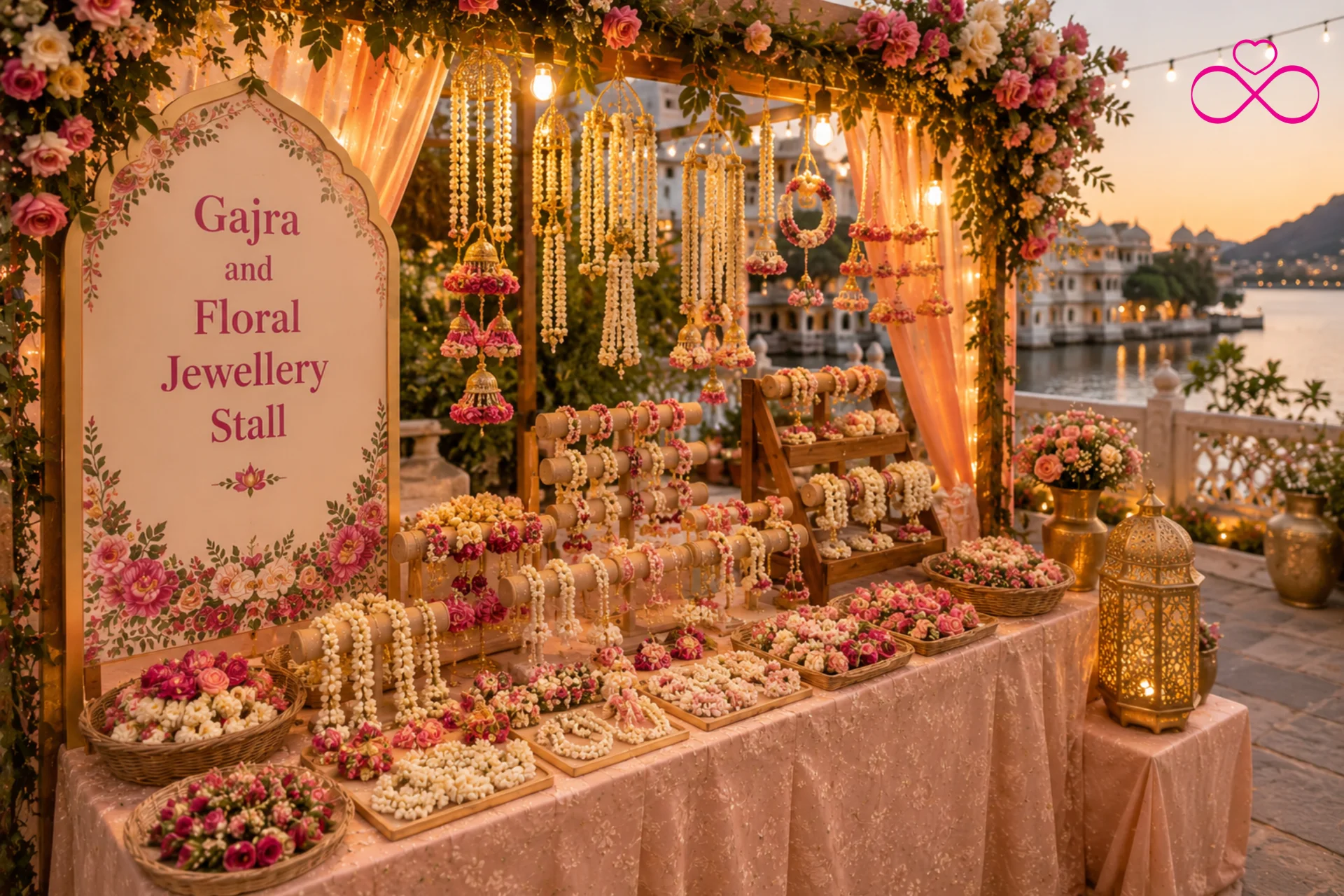
7. Gajra and Floral Jewellery Stall
Gajra - the jasmine string woven into a braid - works on a different sense than sight. Guests smell it before they see it. They slow down before they have consciously registered what is there. The scent does the marketing. For guests who grew up wearing gajra, encountering it at a wedding triggers something specific - the smell of a grandmother's hair, a temple on a festival day, someone else's wedding years ago. A gajra stall does not need to compete for attention. It earns it without trying.
Beyond gajra, a well-stocked floral jewellery stall includes marigold and rose hair clips, floral wristbands, pressed flower hairpins in the wedding colours, and mini floral tiaras. Keep the selection tight - six to eight options - and keep everything fresh. Synthetic florals are not an acceptable substitute here. The moment the scent is missing, the stall loses most of its appeal. Budget for fresh restocking if your function runs longer than three hours, especially at outdoor or warm venues.
Best suited for:
- Mehendi and Haldi Carnival functions - where fresh flowers are already part of the visual language.
- Outdoor destination weddings, especially at those Maharashtra resorts that revolve around the Natural theme.
- Maharashtrian wedding aesthetics, where these options would standout.
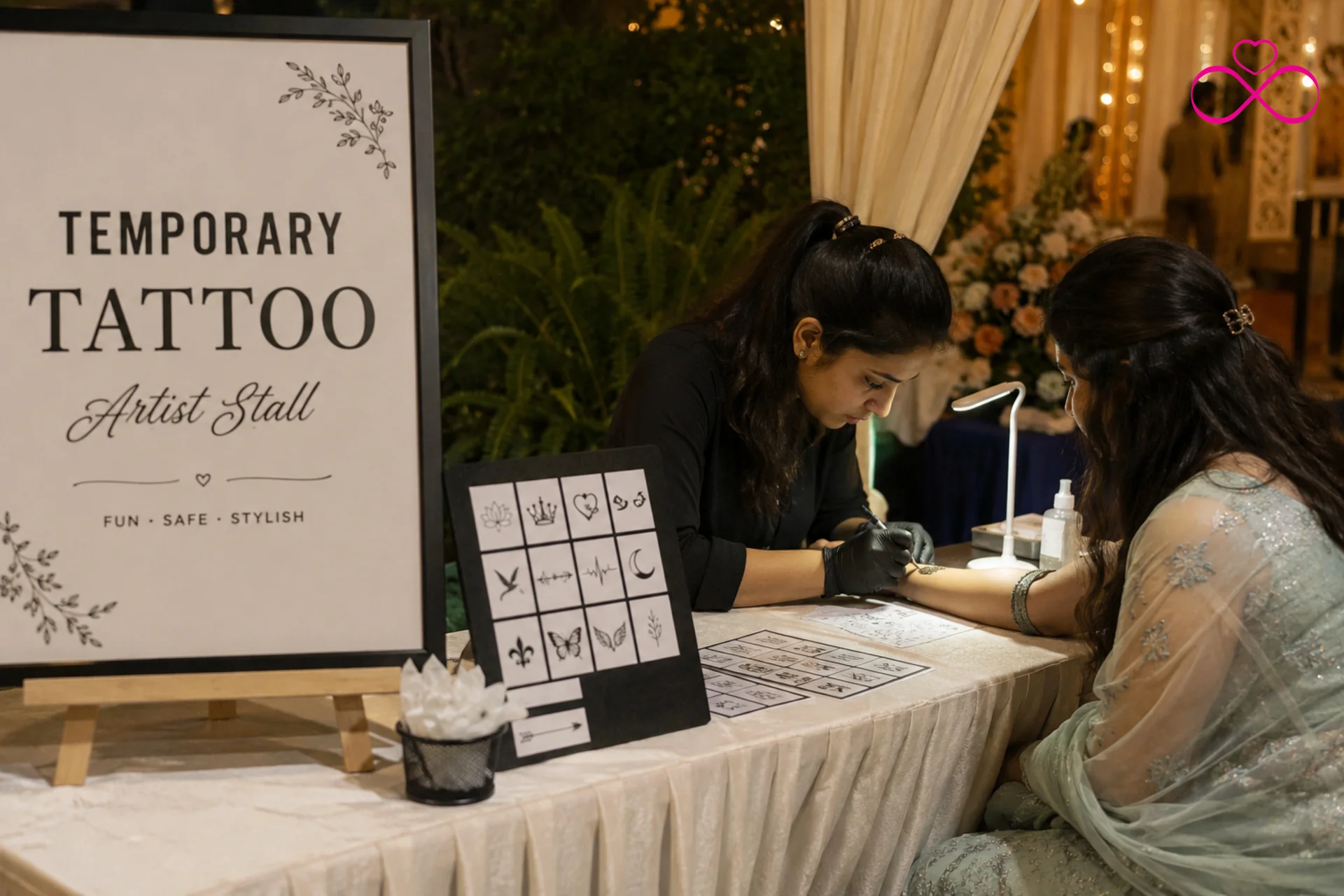
8. Temporary Tattoo Artist
Not henna - and not plastic sticker tattoos either. A professional temporary tattoo artist at a 2026 Indian destination wedding uses skin-safe ink, works freehand or with stencils, and brings a proper lookbook: fine line botanicals, geometric shapes, words in different scripts (Devanagari, Roman, Arabic), small celestial motifs, and wedding-specific designs like the date in Roman numerals. The whole thing takes five to fifteen minutes per design. Custom requests on the spot separate a professional from a kit-and-stencil operation, and guests will ask.
This stall draws a specific crowd - the wedding party, the groom's younger cousins, the bride's college friends - and the group dynamic makes it better. Guests get competitive about their designs; they show each other what they've chosen, someone goes larger than planned because their friend did. Seat the artist near the bar, or the caricature stall, and foot traffic takes care of itself.
Best suited for:
- Sangeet night and cocktail evening - the setting fits the energy of the stall.
- Goa destination weddings with a young, urban guest list, where temporary tattoos are already culturally normal.
- Multi-day weddings where you want to give guests something different on day two.
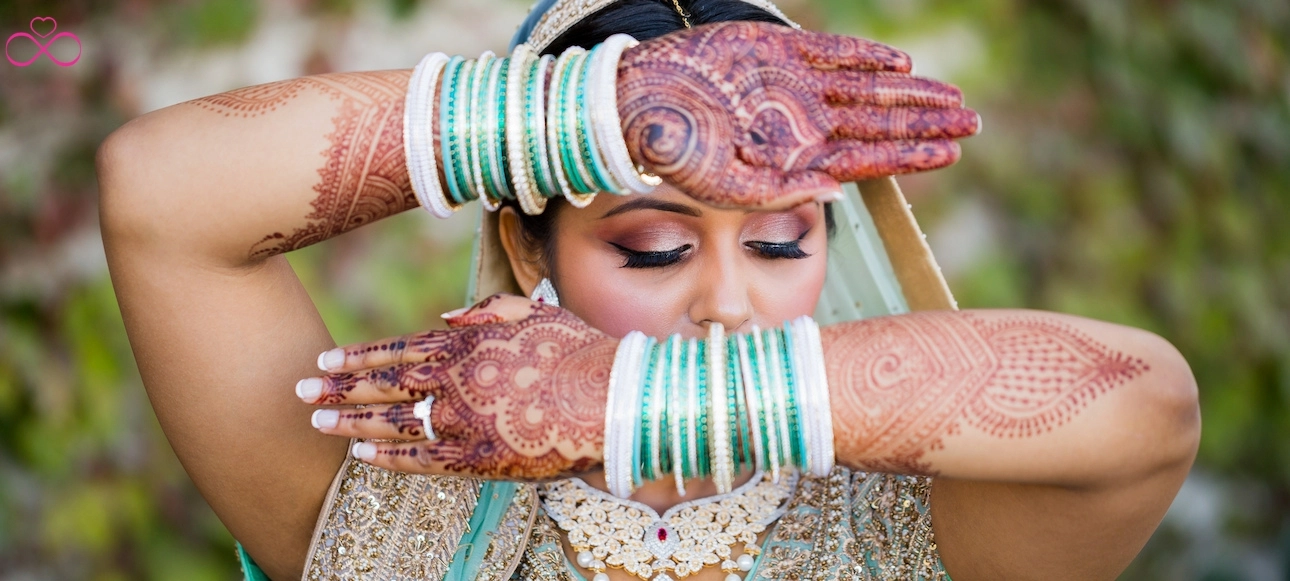
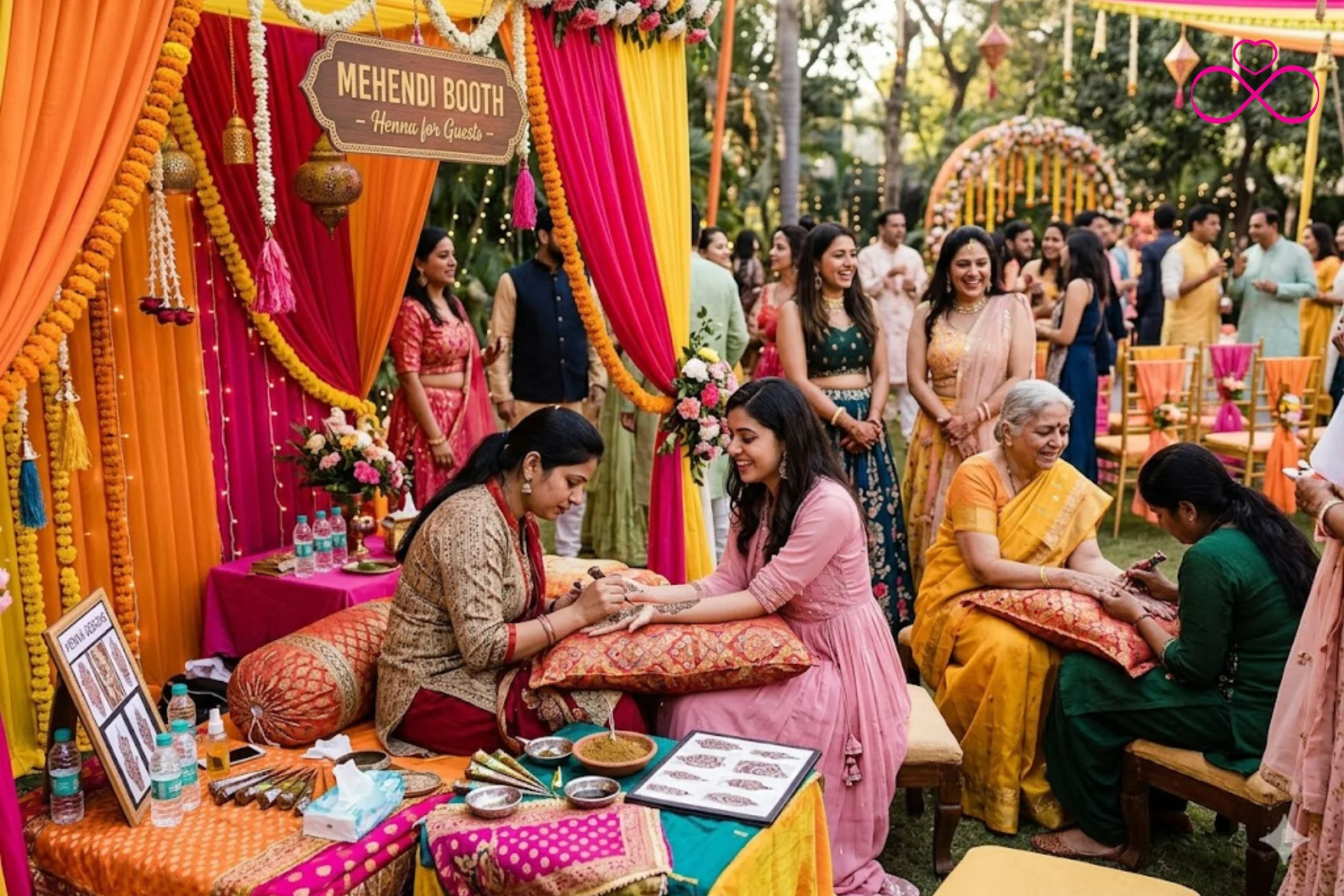
9. Mehendi Booth for Guests
This is separate from the bride's Mehendi ceremony. A guest Mehendi booth is a standalone stall - often set up during the cocktail hour or Sangeet - where guests get small henna designs for themselves. A wrist motif, a finger design, the couple's initials, and a small floral on the back of the hand. Nothing full-sleeve. Fast, personal, and one of the most requested guest activities at Indian destination weddings right now. Book at least two artists for guest counts above 80 - children alone will occupy one artist for longer than expected.
One detail worth the minimal effort: have a printed aftercare card at the stall. It should explain how long to let the Mehendi dry and what to apply afterwards. Guests from outside India - or guests who haven't worn Mehendi in years - will smudge their design within twenty minutes without it. The card protects the quality of the design and makes the stall look thoughtfully managed, not just booked and dropped in.
Best suited for:
- Before the Sangeet evening and after check-in, the guests are unhurried, and the function has a relaxed tempo.
- Multi-day weddings - especially on day one when guests are fully settled in.
- Weddings with NRI or international guests who specifically want to experience Mehendi - this stall is the right context for that.
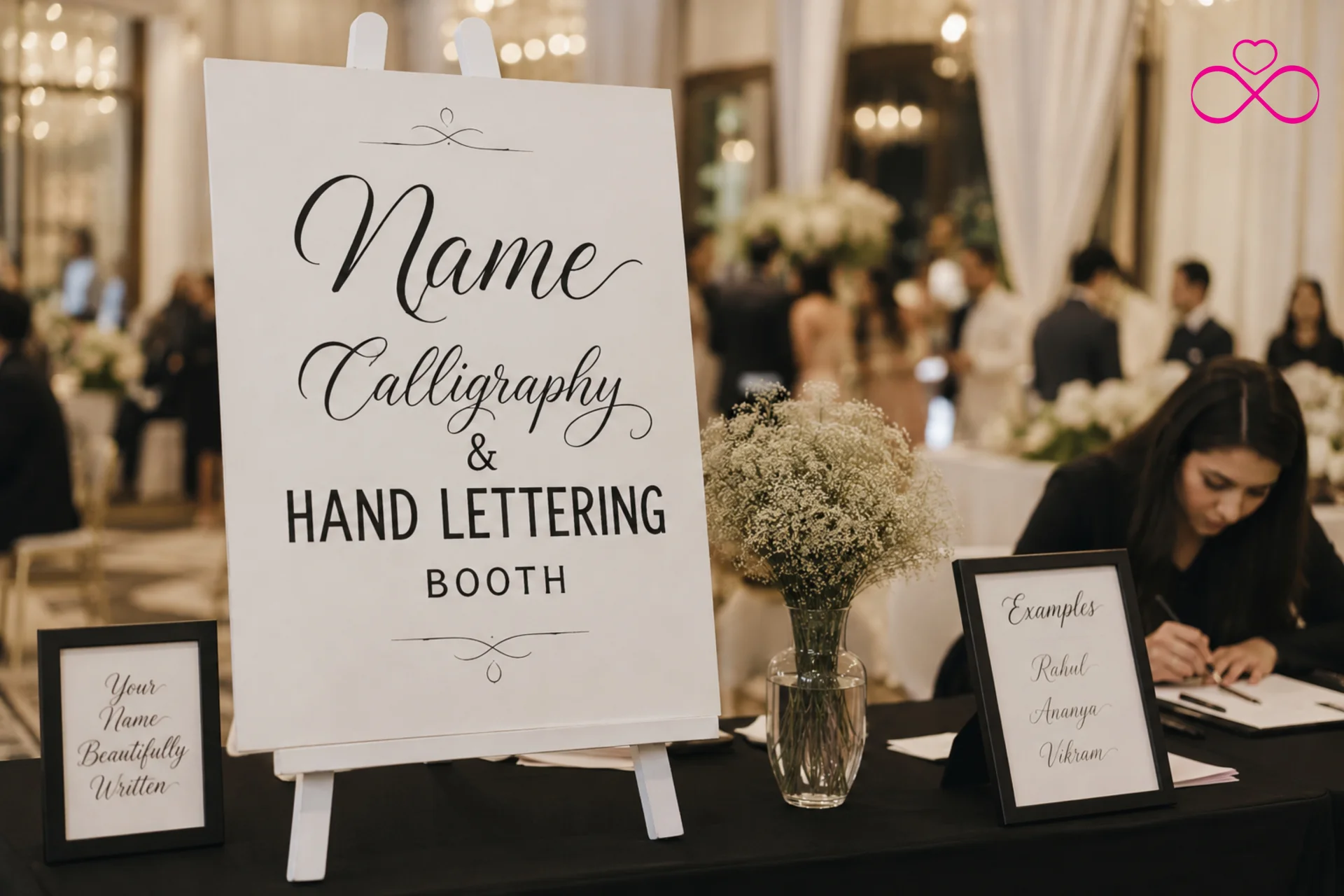
10. Name Calligraphy and Hand Lettering Booth - The Sleeper Hit
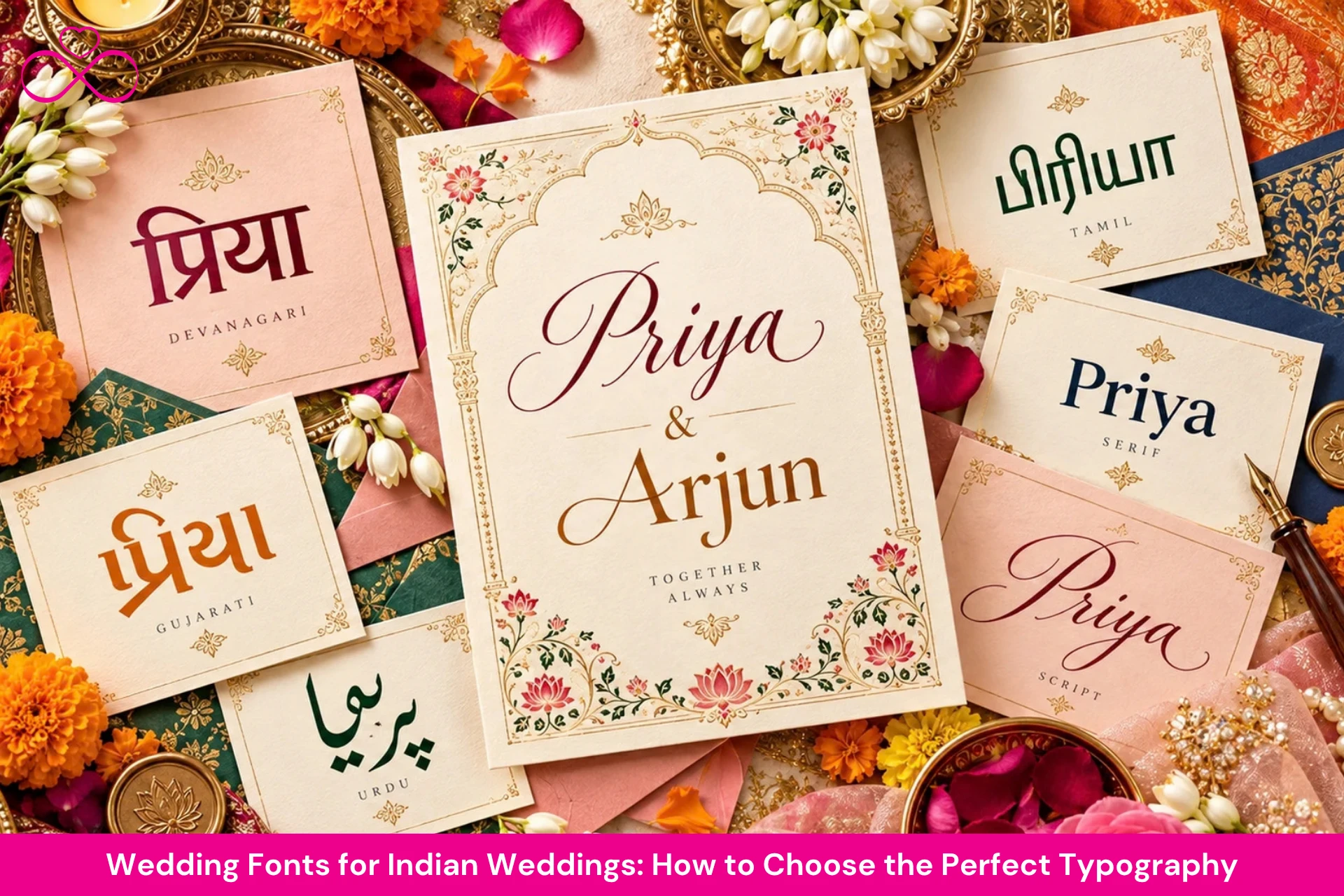
Most destination wedding couples have not considered this stall, which is exactly why their guests enjoy finding it. A professional calligraphy artist writes names, short phrases, or personalised wishes on pre-cut cards in real time. Guests pick what they want written, watch it happen - a calligraphy artist at a small lit table draws viewers before the first piece is done - and carry the result carefully through the rest of the function. Years later, someone finds it in a drawer and remembers the wedding specifically because of it.
The format that works best: ivory or linen cards with the couple's names and wedding date printed small at the bottom, the guest's name written in calligraphy as the centrepiece. A ready-made souvenir with zero effort from the guest. Offering script choices - Latin calligraphy, Devanagari, Urdu - adds a cultural dimension that lands especially well at weddings with mixed regional or international guest lists. The stall needs a small table, good light, and one skilled artist. It can sit in the quietest corner of your venue and still earn a queue once word gets around.
Best suited for:
- Sajjankot and sit-down dinners - functions with a slower tempo where guests have time to seek out the stall.
- Intimate destination weddings with smaller guest counts, where a personalised keepsake feels especially appropriate.
- Heritage venue weddings in Rajasthan- the craftsmanship aesthetic of the venue and the stall are in conversation.
11. Live Wedding Illustrator
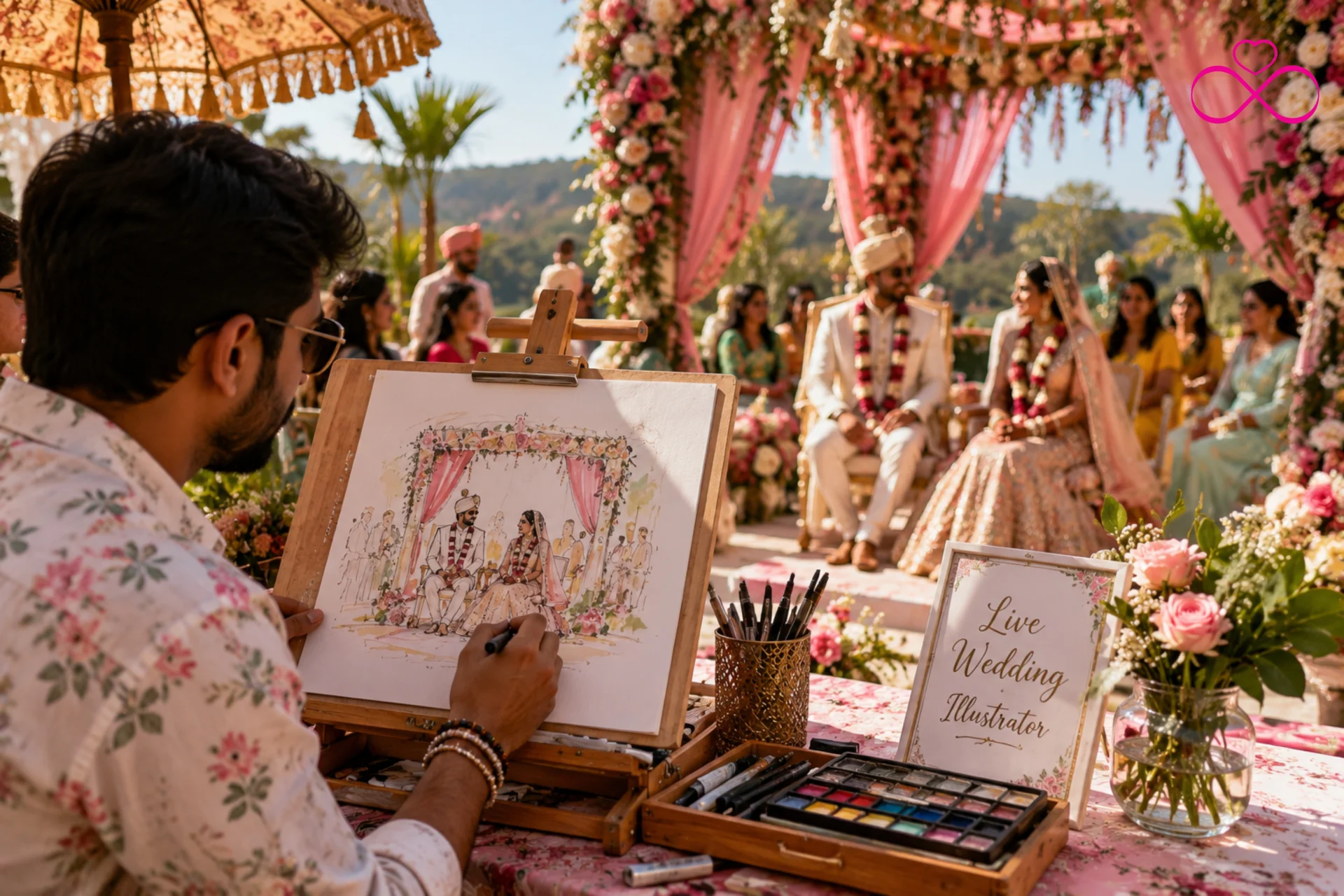
A live wedding illustrator sets up an easel at the edge of the main event space - with a clear view of the mandap, the sangeet stage, or the couple's seat at the reception - and paints the scene as it unfolds. Guests notice the easel early and check back on it through the evening. By the time the function ends, there is a finished painting made at the wedding, of the wedding, which the couple takes home. No other vendor on this list produces something that will still be on a wall twenty years from now.
Watercolour is the most practical medium for live wedding illustration - it dries fast, photographs well even before it is complete, and the loose, luminous quality it produces suits wedding settings better than oils or acrylics. Most live wedding illustrators in India charge between ₹15,000 and ₹45,000, depending on the size of the final piece and their experience. That is not a low number, but compare it to what couples typically spend on a physical gift to each other, or a floral installation that is photographed and dismantled the same night. The painting stays.
Best suited for:
- Reception and Sangeet - functions where the couple is in a relatively fixed position for long enough to be painted meaningfully.
- Lakefront weddings - the visual context adds to what the illustrator captures, and the paintings from these venues are among the more striking wedding keepsakes we have seen.
- Couples who want one significant, non-digital keepsake from their wedding day - this stall produces exactly that.
12. Attar & Fragrance Blending Bar 🌹
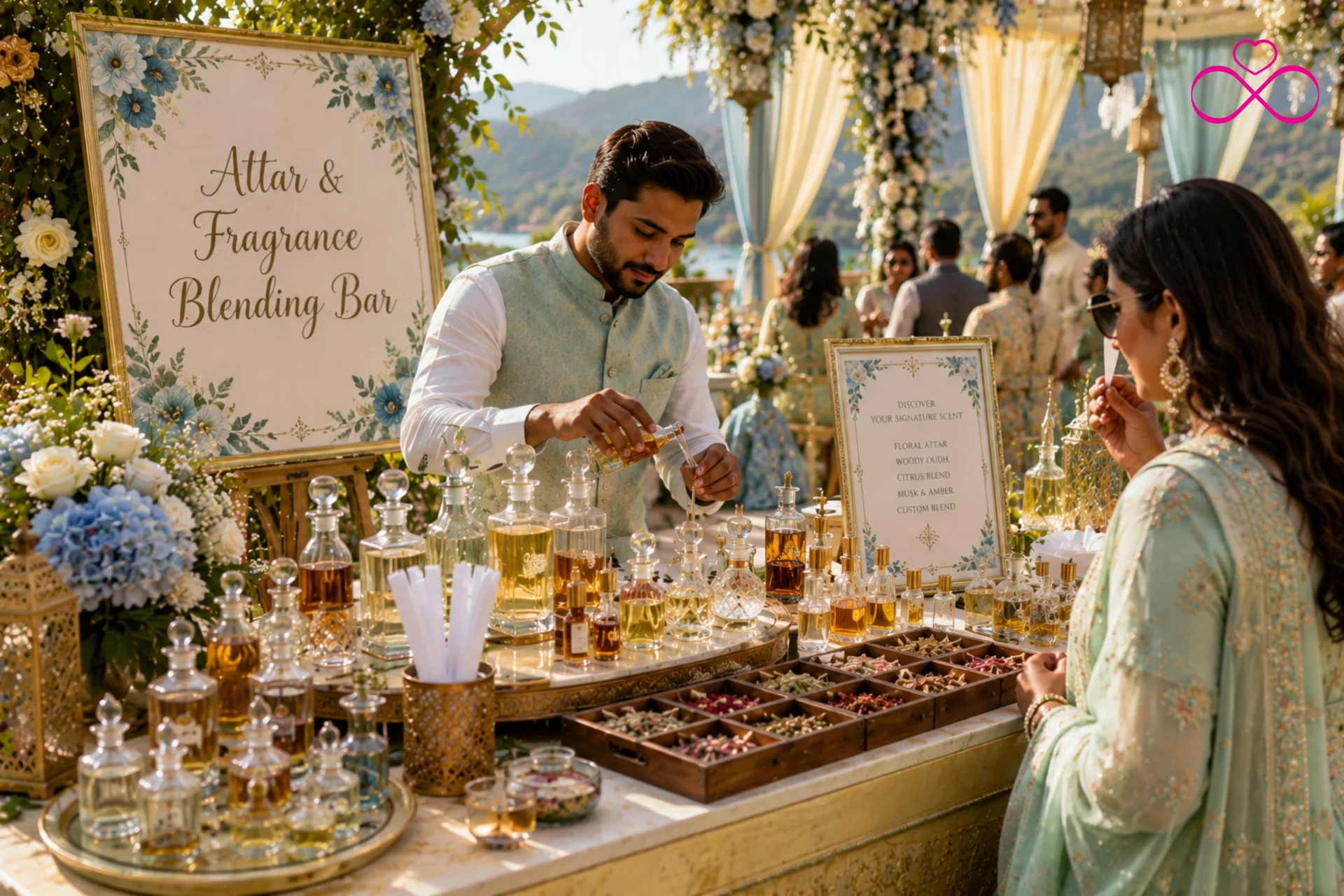
Attar - the concentrated natural perfume oil distilled from flowers, woods, and spices - has been part of Indian wedding culture for centuries. The groom's sehra is scented with it. Guests traditionally receive itr as a gesture of welcome at formal functions. A live attar blending bar at a destination wedding takes that tradition and turns it into an interactive experience: a master itr-maker with twenty to thirty base attars in small bottles, guiding guests through the process of blending their own personalized scent. Guests leave with a small corked vial of something they made themselves, labelled with the wedding date. It is an unusual take-home that does not collect dust on a shelf.
This stall is far easier to source at Rajasthani and UP destination weddings - Kannauj in Uttar Pradesh is the centre of Indian attar production, and artisans who work events are available through local wedding planner networks in Jaipur and Agra. In other destinations, it takes a little more searching, but the category exists. The setup is minimal: a small table, the attar bottles arranged by fragrance family, small glass vials for blending, and the artisan's expertise. The conversation the artisan has with each guest - explaining which base notes combine well, what the specific attar is made from - is itself the experience. Budget roughly around ₹20,000 for the session.
Best suited for:
- The Haldi Carnival function, where guests are willing to spend five to ten minutes at one stall and explore new stuff
- Rajasthani destination weddings in Jaipur, Udaipur, and Jodhpur, where the attar tradition has genuine cultural roots and local artisans are available without importing anyone.
- Couples whose wedding aesthetic is heritage-forward or craft-led - the attar bar fits a Mughal, haveli, or traditional Indian brief in a way that a photo booth never will.
Which Stalls Go Together - Quick Combinations by Function:
You don't need all twelve. Three to four stalls per function is the right number - any more and you dilute the energy of each one. Here's what works together:
- Mehendi morning: Bangle stall + Gajra stall + Saree draping artist + Guest Mehendi booth - all adornment, all sensory, all immediately photographable.
- Sangeet night: Caricature artist + Temporary tattoo artist + Photo booth - high energy, social, Instagram-friendly, the three stalls feed each other's traffic.
- Cocktail hour or reception: Calligraphy booth + Attar blending bar + Live wedding illustrator - quieter, more considered, suited to functions with a slower tempo where guests have time to stay at one stall for five minutes.
- Heritage venue combination (Rajasthani or Mughal aesthetic): Attar bar + Safa tying stall + Live illustrator + Gajra stall - every element connects to the location's cultural context, and the stalls reinforce each other's aesthetic rather than competing.
If you need help choosing which stalls suit your specific venue and guest list - or want to source reliable artists in Udaipur, Goa, Jaipur, or Jaisalmer - the Eternal Weddingz planning team has on-ground vendor relationships across every major Indian wedding destination. They know who shows up prepared and who answers their phone the morning of the function. That last part matters more than any review ever will.